Take the Hint

I used to have a boss who felt that the universe gave him messages about his life. He was constantly saying things like, “I’ve run into three people lately who have problems with alcohol. I think that the universe is trying to tell me something.” He would then lay off drinking for a week or two, until the universe told him to do something different.

If I were him, I would think that the universe is trying to tell ME something right now.

My manuscript, Jim and Jack, was originally literary fiction, but thanks to a lot of online advice, I have reluctantly morphed it into something more commercial. Although the story is definitely more streamlined, it is no longer the relaxing summer’s day that it was, and I don’t think that it’s as good in many ways. A few things have improved, such as the action starting earlier, but overall, it sounds just like everybody else’s “voice” these days. This has bothered me so much that I’ve even stopped querying, paralyzed about which version to send if I get another request.

Until this week. My author-hero Ty Roth posted about this very topic. So did literary agent Rachelle Gardner. Victoria Mixon had a superb (and I NEVER use that word) post about young adult literature and how all of the edgy/disturbing YA stuff isn’t healthy for kids, and when I left a comment, she replied with, “Layinda, aim for your star. Forget the nay-sayers. Nobody knows what’s going to sell, only that trends are started by people with the guts to go where no one else is going. “We are the makers of manners, Kate.”—Henry V

Now, I don’t think that the universe tells anybody anything, but these posts have resonated with me, and my mind is made up. I am going back to the original version, and I will let the professionals decide whether my manuscript is any good or not. From what I understand, there are always rewrites anyway. 

If you missed any of these excellent posts, here are the links:

Ty Roth:
http://tyroth.wordpress.com/2010/06/17/the-secret-to-my-success/

Rachelle Gardner:
http://cba-ramblings.blogspot.com/2010/06/write-from-your-heart-or-follow-trends.html

Victoria Mixon: http://www.victoriamixon.com/advice/2010/06/14/honestly-or-sensationally-addressing-ya-taboos/comment-page-1/#comment-143

8 Comments

Filed under Critical Thinking, Miscellaneous, Uncategorized, Writing

Author Series – Gone but Not Forgotten: Gene Stratton-Porter

Gene Stratton-Porter was born in Lagro, Indiana on August 17, 1863. Christened Geneva Grace, she was the youngest of twelve children. When Geneva was three, her mother was taken ill with typhoid fever and never fully recovered, so the little girl spent most of her early years outdoors in the company of her father and brothers. During this time, she fed baby birds in the nest, collected moths and generally immersed herself in nature. When she was twelve her mother died, and the family spent the next several years moving between the homes of Gene’s married sisters.

Gene Age 10

In 1883, Gene met Charles D. Porter at a religious revival. Three years later, she married the successful pharmacist and the couple built a home, “Limberlost,” by the Limberlost Swamp near Geneva, Indiana. They later built another residence, “The Cabin in Wildflower Woods,” located near Rome City. (Both are now Indiana State Historic Sites.)

An early environmentalist, Gene wrote popular novels for young adults that took place in natural settings. After achieving financial success as an author, Stratton-Porter developed her own production company in Los Angeles, and most of her books were made into movies. On December 6, 1924, she died in a streetcar accident during one of her trips to California. She was fifty-one years old. After Stratton-Porter’s death, her only daughter, Jeannette Porter Meehan, wrote sequels to several of her mother’s novels.

During her lifetime, Gene Stratton-Porter wrote a total of twelve novels, the most famous of which were Freckles and A Girl of the Limberlost. She also wrote nature studies and books of poetry. It is estimated that she had a readership of fifty-million at the time that she died. Most of her titles are still in print, and are also available as free Kindle downloads from Amazon.com.

Gene Stratton-Porter: A Little Study of Her Life and Work, published by Doubleday, Page and Company in 1915 and again in 1926, is an excellent biography created largely from the author’s personal records and writings. It can be viewed online at http://digital.library.upenn.edu/women/stratton/gene/gene.html

Freckles


———-

The Keeper of the Bees (Library of Indiana Classics)


Sources:

Gene Stratton Porter State Historic Site
http://www.genestratton-porter.com/Biography.html

Wikipedia
http://en.wikipedia.org/wiki/Gene_Stratton-Porter

Lesson Tutor
http://www.lessontutor.com/eesStrattonPorter.html

Indiana State Museum
http://www.indianamuseum.org/sites/gene.html

Our Tentative Times
http://www.tentativetimes.net/porter/limber2a.html

Penn Libraries
http://digital.library.upenn.edu/women/stratton/gene/gene.html

Google Images
http://www.google.com/images?client=safari&rls=en-us&q=gene+stratton-porter&oe=UTF-8&um=1&ie=UTF-8&source=univ&ei=EkUVTJyTJcKC8gaMk5SbCg&sa=X&oi=image_result_group&ct=title&resnum=4&ved=0CD8QsAQwAw

The Literature Network
http://www.online-literature.com/stratton-porter/

Our Land, Our Literature
http://www.bsu.edu/ourlandourlit/literature/authors/portergs.htm

Gene Stratton-Porter and her Limberlost Swamp
http://www.genestrattonporter.net/

2 Comments

Filed under Author Biographies, Miscellaneous, Reading, Writing

Topping the Charts

I found myself idly wondering this morning what the most popular book of all time was. I did a Google search, and Soyouwanna.com listed the ten most popular, so I checked it out. They freely admit that their stats are only on books with available sales figures, but their list still provides a general idea of what folks have preferred. Here it is:*

10.In His Steps: What Would Jesus Do?In His Steps: “What Would Jesus Do?”
Author: Rev. Charles Monroe Sheldon
Copies sold: 28,500,000

9. Go to "Valley of the Dolls" page Valley of the Dolls
Author: Jacqueline Susann
Copies sold: 30,000,000

8. Go to "Dr. Spock's Baby and Child Care: 8th Edition" page The Common Sense Book of Baby and Child Care
Author: Dr. Benjamin Spock
Copies sold: 39,200,000

7. Thumbnail for World Almanac and... The World Almanac
Author: Who knows?
Copies sold: 40,000,000

6. Go to "A Message to Garcia: And Other Essential Writings on Success" page A Message to Garcia
Author: Elbert Hubbard
Copies sold: 40-50,000,000

5. Go to "McGuffey's Eclectic Readers/Boxed" page The McGuffey Readers
Author: William Holmes McGuffey
Copies sold: 60,000,000

4. Go to "Guinness World Records 2010: Thousands of new records in The Book of the Decade!" page The Guinness Book of Records
Author: Who knows?
Copies sold: 81,000,000

3. The American spelling book: containing the rudiments of the English language for the use of schools in the United StatesAmerican Spelling Book
Author: Noah Webster
Copies sold: 100,000,000

2. Go to "Quotations From Chairman Mao Tse-Tung" page Quotations from the Works of Mao Tse-tung
Author: Mao Tse-tung
Copies sold: 800,000,000

1. The Holy Bible King James Version: King James VersionThe Bible
Author: God
Copies sold: 6,000,000,000

What I find interesting is that only one of the books would be categorized as fiction.** Reference books, religious works, “how to” manuals and dogma all outrank the imagination for supplying a good read. That Valley of the Dolls must be some book!

*To see the complete annotation, go to their website.

**For those of you who — like me — have never heard of A Message to Garcia, it is a motivational true story.

5 Comments

Filed under Critical Thinking, Miscellaneous, Reading, Uncategorized

I Really Should Be Working…

I have posted previously about the benefits of procrastinating. It allows the subconscious to have some important incubation time, helps clear out the mental cobwebs, and diffuses inner conflict on days when writing is more of a struggle than a joy.

In the spirit of providing tools for avoiding writer’s block, I have annotated a few good, free websites that are a wonderful way to change gears while scoring some brownie points with the inner child. 

braingle.com
This site is a storehouse of brain teasers and mental challenges to delight even the most self-disciplined of writers. 

Goodhousekeeping.com
You might be happy to just read the articles on this website, but if you go to the “games” section, you will be even happier. Spliterature and Mah Jong Dimensions are two of my favorites. Note: you have to scroll to the bottom of the home page to find the correct tab.

TestQ.com
Lots of fun and informative tests to take, that range from measuring your I.Q. to determining what your favorite color says about you. This site is a pleasant way to pass the time when you really should be researching the proper way to write a query letter. 

Facebook.com
I guess I don’t really need to describe this one, but I can highly recommend the Scrabble Beta game.

Lego.com
It’s not just for kids anymore. There are many terrific games on this website (category: Play) that will engage even the mature writer. My favorite is Junkbot, where you have to guide a lego robot across a series of blocks that gets more challenging with every level.

Note: A good trick to keep the goofing-off to a manageable level is to set a timer. When the buzzer goes off, get back to work.


2 Comments

Filed under Miscellaneous, Uncategorized, Writing

Monday Author Series – Gone but Not Forgotten: Marguerite Henry

Marguerite Henry

Marguerite Breithaupt Henry was born on April 13, 1902, in Wisconsin. When she was eight years old, she fell victim to rheumatic fever and was an invalid for several years. Confined to bed, there wasn’t much to do in those days but read and write, and so that’s what she did. At age eleven, she entered one of her stories in a magazine contest and won, resulting in her first publication. After fully recuperating, she went back to school and continued on to college, where she received a degree to teach English.

After she married Sydney Crocker Henry in 1923, she started submitting some of her stories to magazines. After some success, she began to write animal books for children, collaborating with illustrator Wesley Dennis on several of her works. Their first endeavor was Justin Morgan Had a Horse, which won a Newbury Honor. Most of her books were about horses, which Dennis excelled at depicting.

Known for her extensive research and the historical accuracy of her stories, her books were very popular with children, and many are still in print. The most famous of her fifty-nine works were, Justin Morgan Had a HorseBrighty of the Grand Canyon, Misty of Chincoteague, Stormy, Misty’s Foal, King of the Wind, and Album of Horses, earning her two Newbury Honors and a Newbury Medal, as well as several other distinguished awards. 

After a long and fulfilling career, she died on November 26, 1997, at age 95.

Justin Morgan Had a Horse

Misty of Chincoteague
 
Brighty: Of the Grand Canyon (Marguerite Henry Horseshoe Library)
King of the Wind: The Story of the Godolphin Arabian
 
Album of Horses


Sources: 

Wikipedia.com
http://en.wikipedia.org/wiki/Marguerite_Henry

Google Images
http://www.google.com/imgres?imgurl=http://favoritechildrensbooks.info/wp-content/uploads/2008/09/margueritehenry.jpg&imgrefurl=http://favoritechildrensbooks.info/&usg=__avHwX6WTwKM6Pw-tUYWqKHa3TtQ=&h=200&w=170&sz=7&hl=en&start=3&sig2=qSPJ7gFnG712aJkF6Bofpw&um=1&itbs=1&tbnid=e2mvKDZQJN_HzM:&tbnh=104&tbnw=88&prev=/images%3Fq%3Dmarguerite%2Bhenry%26um%3D1%26hl%3Den%26client%3Dsafari%26sa%3DX%26rls%3Den-us%26tbs%3Disch:1&ei=hz8NTL6NIYH6lweGlJGYDg 

Greenville Public Library
http://www.yourlibrary.ws/childrens_webpage/j-author42001.html

Answers.com
http://www.answers.com/topic/marguerite-henry

4 Comments

Filed under Author Biographies, Miscellaneous, Reading, Recommended Reading, Uncategorized

Que(ry) Sera, Sera.

Getting rejected is no fun. It’s part of the writing game, though, and so instead of complaining about it, it’s a good time to take stock.

If you are lucky enough to get a personalized rejection, you at least have some feedback to consider. Whether the agent didn’t connect with your work, or if they’re already repping a similar manuscript, you can take that for what it’s worth and continue on.

A form letter is a different animal (and don’t think that they don’t happen with partials/fulls). You have no idea why your work has been rejected, what might be wrong with it, or how to fix it. You can guess, but should you go to the trouble of rewriting, or just assume that you haven’t hit the right agent yet?

Critique partners and beta readers can be helpful, to an extent, but in the end, you are still the one who decides whether their suggestions  are good ones or not. If you are getting the same comments over and over, like, “it doesn’t flow well,” or, “your main character is unlikable,” it’s time to pay attention and do some editing. Otherwise, just keep an open mind, and keep researching agents/sending query letters.

Sooner or later, you’ll hit the jackpot, or you’ll write something better, or you’ll crawl into a literary hole and decide that maybe writing wasn’t the life for you, anyway.

However it works out, it will.

3 Comments

Filed under Critical Thinking, Miscellaneous, Uncategorized, Writing

Make Way for Goslings

This morning, I was heading East in the left hand lane of the highway when I spied two Canada Geese and their six or so goslings strutting out from the grassy median, headed for the pavement. As soon as I passed, the parents hurried their babies into the road, and my eyes were glued to the rear-view mirror to check out their fate. “Hurry up, Goosies!” I rooted.

They had a good shot at it, as there were no more cars for about a quarter mile, and that one switched lanes in time to avoid a collision. I held my breath until the family got across, happy to see them arrive at the other side. They still had an off-ramp to negotiate, but as far as I was concerned, they were safe. Directing my attention back to the road, I realized that before their trek across the eastbound lanes, the geese had already crossed one off-ramp and the two westbound lanes. 

The parents had seemed to wait for traffic to clear before heading across the highway, but I was impressed that they would take such a risk. Geese are notoriously overprotective of their offspring. Anyone who has ever come too close to a goose with goslings knows that they will hiss, bite and even chase you away if you get too close. The search for a better grazing field must have been imperative.

It occurred to me that writers basically go through all of the stages of eggdom with our manuscripts. An idea presents itself, and we incubate it with our time and creativity until a story hatches out. We nurture our fuzzy chick through the editing process until it is time to send it out into the world of querying to see if it will fly. Sometimes we are driven to make our way through the field of writing groups and critique partners to strengthen and rework our writing for the best results. With vigilance, a lot of luck and a little encouragement from our friends, we make it to the other side in one piece, hopefully wiser and with the experience needed to continue the journey.

Go, geese!

3 Comments

Filed under Writing

The Ultimate Sacrifice

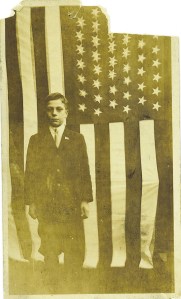
Grandpa at his brother’s memorial service, 1920.


When he was very young, my older brother was in danger of getting drafted when he turned eighteen. Much to our mother’s relief, Nixon ended the draft in 1973, and I never had to worry about a sibling going off to war.

My grandpa wasn’t so lucky. While his seventh grade class was busy knitting vests for soldiers overseas, his own big brother, Howard, was caught up in the fervor to fight The War to End All Wars, and enlisted in the infantry. In May 1918, after seven months of training at Camp Hancock, he departed for France. Two months later, on the first day of his regiment’s confrontation with the enemy, Howard was killed by machine gun fire in the Conde Woods.

A comrade reported seeing him lying wounded a few hours after the attack, asking for water, but the man had none and knew that the enemy was returning, so he left without helping. A few days later, a patrol looking for bodies found Howard’s about 200 yards from where he had last been seen, and buried him with twelve other soldiers in a grave near Marne. Two years later, his body was disinterred and shipped back to Pennsylvania, where he received full military honors.

My grandfather said that his parents were in denial when they got the news of Howard’s death. When the remains were finally returned home, the family was offered the opportunity to identify the body, but declined. As a result, his father was able to hope until the end of his days that there had been a mix-up, and that Howard might someday return.

He didn’t.

This post is dedicated to brave men long forgotten, and to the families that had to go on without them.

References: History of the 110th Infantry (10th Pa.) of the 28th Division, U. S. A. (Published by The Association of the 110th Infantry, 1920); Personal recollections of Clair H. Brewer, Sr.

7 Comments

Filed under Miscellaneous

Ghost from the Past: Elements of the Modern Novel

I fell asleep last Saturday night with the TV on. When I woke up in the morning, the movie Ghost was just starting. Ghost is my brother’s favorite movie, but I had never seen it. Twenty years of mild curiosity (and my reluctance to crawl out of bed before I absolutely had to) overcame me, and I flopped back onto the pillows to watch.

It didn’t take long to see why the film was such a hit, and not much more time to realize that the movie includes many elements of a good novel. (Note: I am assuming that everyone else has already seen Ghost. If you haven’t, head over to Netflix before you read any further —I don’t want to spoil it for anyone.)

1. Hook the Reader:
After some eerie but beautiful music and a brief pan of what appears to be a dusty attic space, the film literally breaks into the action with a sledgehammer through a wall. We are immediately introduced to the main characters (Sam and Molly) and their relationship. Once a reader is hooked, he/she will keep reading.

2. Work in backstory as you go along:
Imperceptibly, we see by his inclusion in the demolition that the couple is friends with Carl, and that he is a coworker of Sam. Swiftly, the viewer realizes that they are bankers, and just as swiftly, that secret codes are best kept secret. Backstory is more easily digested when it is revealed as needed.

3. Only include information that advances the plot or exposes character (to paraphrase Mr. Vonnegut):
We never do find out why the lovebirds seem to have no close friends except for the bad guy, but that doesn’t really matter. If it’s not pertinent to the story, the reader can live without it.

4. Weave in subplots: Oda Mae’s history of being a con artist messes up the original plan of convincing Molly that she needs to protect herself. It is also intriguing that the subway ghost seems to have been a victimized homeless person, and the $4 mil check ends up benefitting a homeless shelter. Subplots lend meaning to a story.

5. Don’t forget the twists: Carl’s character is an impressive source of the unexpected. First, he turns out to be the enemy instead of a friend, THEN he comes on to Molly after Sam’s death, and instead of being scared away by Sam’s ghost, he blackmails him with a threat on Molly’s life. Twists keep the reader engaged.

6. Give the reader the inside scoop:
The audience knows that Carl is the bad guy, but somehow, Sam just doesn’t get it. The suspense is in whether or not he will figure it out before it is too late, and the viewer is worried for him and Molly. A reader will root for a character who is at risk but doesn’t know it.

7. Include some foreshadowing:
There is plenty of foreshadowing in Ghost. “Can you keep a secret?” asks Sam of Carl, right before he goes on to tell him  about the confusion with the accounts. (We know how that turns out!) Later, a ghost mentions in passing [pun intended] that entering someone else’s body is debilitating, but we forget all about that until Sam is suddenly stricken after a visit á la Oda Mae. We also get a dash of premonition when the hospital ghost says that the dead guy was lucky to go to heaven, because sometimes it goes the other way. Foreshadowing adds dimension to a problem/conflict. 

8. Focus on character development: When Sam is first dead, he is completely powerless. As the film progresses, he grows in ghostly knowledge and capabilities, seeking out other ghosts to teach him. He also discovers Oda Mae and achieves his goal of communicating with Molly. By the end of the story, he has used his hard earned skills to save the her. Oda Mae changes from being a con artist to fulfilling her destiny as a ghost whisperer and making a positive difference in people’s lives. Carl experiences character development as well, going from getting involved with the wrong guys to being responsible for a murder. In greedy desperation, he turns into a murderous villain, himself. Character arcs are integral to good storytelling. 

9. Fake out the reader for more suspense: We think that the action is on its way to being wrapped up, with the murderer gone and Sam in full possession of his ghostly capabilities, but he is unexpectedly weakened at the moment of crisis, and we don’t know what is going to happen. Lead the reader through a maze of possibilities to heighten the tension.

1o. Incorporate themes: The most obvious themes in Ghost are “good vs. evil,” and “love conquers all.” Without them, Ghost would be just another urban paranormal. Archetypes grab the reader on a gut level.

11. Denouement:
Immediately after Carl bites the dust and heads South, the pace slows, and we enjoy a leisurely stroll to the end of the film. The swirling light from heaven enables Molly to see and hear her beloved, and there is a tender moment between them as they say goodbye for the last time. The film wraps up with Sam departing for the great beyond. After the crisis has passed, let the reader catch their breath.

12. Tie up loose ends:
Both bad guys are dead, Sam and Molly have exchanged words of love, Oda Mae has turned over a new leaf. Conclusion achieved. Don’t leave unanswered questions (unless you plan a sequel).

A lot of things have changed in twenty years, including Demi Moore’s nose, but the elements of good storytelling will never die.

4 Comments

Filed under Writing

What You See is What You Get

There is an interesting aspect to vision that many people aren’t aware of. When we look at something, it seems as though we are viewing a homogenized image, as if the body’s camera has all of its pixels activated and every nuance is just waiting to be observed.

Except that we’re not. It is a fascinating fact that the end result of what we see is much different than what our eyes actually observe. Our brains translate two separate points of view, compare and constrast shades of color, and translate the dramatic delineation of objects into a picture perfect scene. While the eyes supply the nuts and bolts of an image, the brain interprets and makes sense of things, filling in the blanks by merging available information with previous experience.

Most of the time, this system works well. Our cognitive ability, combined with the movement of the head to scan an area, usually enables us to see what there is to see. Sometimes, though, we think we see things that upon second glance are really something different, like when a cat runs across the road but then we realize it was a fox, or when we look down into the Grand Canyon and things appear to be 2-dimensional even though we know they are 3-dimensional. 

In many ways, this is similar to the picture that happens in our heads when we read.  The author supplies bits and pieces, and the reader fills in the blanks. Most people don’t need 100% of the image to see what’s going on. A character might be “a six year old female, 3’4,” sixty pounds, with braided blonde hair, eyebrows in a darker shade, blue eyes and knobby knees,” but, “A chubby little girl with blonde braids and a determined expression” is really all the reader needs, unless the knobby knees figure into the story somehow.

For centuries, readers have depended on this flow of communication between author and psyche to provide enduring mental images. These days, however, there seems to be a tendency for writers to either blatantly spell things out (always showing, never telling) or to skip details entirely (eliminating adverbs and adjectives), leaving the reader bereft of the joy of “the movie in your head.”

The Help, by Kathryn Stockett,* is one of the most engaging books that I’ve read in a while, and I happily stayed up late to finish it. The reason that I didn’t give it a higher rating was because after I read it, I didn’t experience my usual reliving-the-best-parts-of-the-story-in-my-head-later afterglow. It was just, “The End.” I was able review the course of events in my mind, and had mental images of the toilets on the lawn, Mae Mobley perched on the pottie in the wrong bathroom, and the stain on Miss Celia’s carpet, but there was a depth of field that was missing. 

What I suspect was at the heart of the problem, was the current trend of deleting most adverbs and adjectives. For me, that removes a lot of the visual aspects of a read. I don’t think that stories should be hazy with purple prose, but I like the subtleties of language that adverbs and adjectives can supply. I enjoy knowing about the quirky eyebrows on the teacher, or that the mother said something in a mysterious way. Those details are parts of the picture that the author has painted, and I want to see them. I don’t go to an art museum to look at a coloring book and fill in the pictures myself — I want to see a completed masterpiece, the world as the artist sees it.

Similarly, I want to see a story through the author’s eyes. If I like it, I like it, if I don’t, I don’t. If a writer wants to fill in some information with an adjective, I’m all for it. My vision is a little skewed, anyway.

* To see my review of The Help, click to read the first-half and final-review posts.

3 Comments

Filed under Uncategorized