Category Archives: Miscellaneous

Take the Hint

I used to have a boss who felt that the universe gave him messages about his life. He was constantly saying things like, “I’ve run into three people lately who have problems with alcohol. I think that the universe is trying to tell me something.” He would then lay off drinking for a week or two, until the universe told him to do something different.

If I were him, I would think that the universe is trying to tell ME something right now.

My manuscript, Jim and Jack, was originally literary fiction, but thanks to a lot of online advice, I have reluctantly morphed it into something more commercial. Although the story is definitely more streamlined, it is no longer the relaxing summer’s day that it was, and I don’t think that it’s as good in many ways. A few things have improved, such as the action starting earlier, but overall, it sounds just like everybody else’s “voice” these days. This has bothered me so much that I’ve even stopped querying, paralyzed about which version to send if I get another request.

Until this week. My author-hero Ty Roth posted about this very topic. So did literary agent Rachelle Gardner. Victoria Mixon had a superb (and I NEVER use that word) post about young adult literature and how all of the edgy/disturbing YA stuff isn’t healthy for kids, and when I left a comment, she replied with, “Layinda, aim for your star. Forget the nay-sayers. Nobody knows what’s going to sell, only that trends are started by people with the guts to go where no one else is going. “We are the makers of manners, Kate.”—Henry V

Now, I don’t think that the universe tells anybody anything, but these posts have resonated with me, and my mind is made up. I am going back to the original version, and I will let the professionals decide whether my manuscript is any good or not. From what I understand, there are always rewrites anyway. 

If you missed any of these excellent posts, here are the links:

Ty Roth:
http://tyroth.wordpress.com/2010/06/17/the-secret-to-my-success/

Rachelle Gardner:
http://cba-ramblings.blogspot.com/2010/06/write-from-your-heart-or-follow-trends.html

Victoria Mixon: http://www.victoriamixon.com/advice/2010/06/14/honestly-or-sensationally-addressing-ya-taboos/comment-page-1/#comment-143

8 Comments

Filed under Critical Thinking, Miscellaneous, Uncategorized, Writing

Author Series – Gone but Not Forgotten: Gene Stratton-Porter

Gene Stratton-Porter was born in Lagro, Indiana on August 17, 1863. Christened Geneva Grace, she was the youngest of twelve children. When Geneva was three, her mother was taken ill with typhoid fever and never fully recovered, so the little girl spent most of her early years outdoors in the company of her father and brothers. During this time, she fed baby birds in the nest, collected moths and generally immersed herself in nature. When she was twelve her mother died, and the family spent the next several years moving between the homes of Gene’s married sisters.

Gene Age 10

In 1883, Gene met Charles D. Porter at a religious revival. Three years later, she married the successful pharmacist and the couple built a home, “Limberlost,” by the Limberlost Swamp near Geneva, Indiana. They later built another residence, “The Cabin in Wildflower Woods,” located near Rome City. (Both are now Indiana State Historic Sites.)

An early environmentalist, Gene wrote popular novels for young adults that took place in natural settings. After achieving financial success as an author, Stratton-Porter developed her own production company in Los Angeles, and most of her books were made into movies. On December 6, 1924, she died in a streetcar accident during one of her trips to California. She was fifty-one years old. After Stratton-Porter’s death, her only daughter, Jeannette Porter Meehan, wrote sequels to several of her mother’s novels.

During her lifetime, Gene Stratton-Porter wrote a total of twelve novels, the most famous of which were Freckles and A Girl of the Limberlost. She also wrote nature studies and books of poetry. It is estimated that she had a readership of fifty-million at the time that she died. Most of her titles are still in print, and are also available as free Kindle downloads from Amazon.com.

Gene Stratton-Porter: A Little Study of Her Life and Work, published by Doubleday, Page and Company in 1915 and again in 1926, is an excellent biography created largely from the author’s personal records and writings. It can be viewed online at http://digital.library.upenn.edu/women/stratton/gene/gene.html

Freckles


———-

The Keeper of the Bees (Library of Indiana Classics)


Sources:

Gene Stratton Porter State Historic Site
http://www.genestratton-porter.com/Biography.html

Wikipedia
http://en.wikipedia.org/wiki/Gene_Stratton-Porter

Lesson Tutor
http://www.lessontutor.com/eesStrattonPorter.html

Indiana State Museum
http://www.indianamuseum.org/sites/gene.html

Our Tentative Times
http://www.tentativetimes.net/porter/limber2a.html

Penn Libraries
http://digital.library.upenn.edu/women/stratton/gene/gene.html

Google Images
http://www.google.com/images?client=safari&rls=en-us&q=gene+stratton-porter&oe=UTF-8&um=1&ie=UTF-8&source=univ&ei=EkUVTJyTJcKC8gaMk5SbCg&sa=X&oi=image_result_group&ct=title&resnum=4&ved=0CD8QsAQwAw

The Literature Network
http://www.online-literature.com/stratton-porter/

Our Land, Our Literature
http://www.bsu.edu/ourlandourlit/literature/authors/portergs.htm

Gene Stratton-Porter and her Limberlost Swamp
http://www.genestrattonporter.net/

2 Comments

Filed under Author Biographies, Miscellaneous, Reading, Writing

Topping the Charts

I found myself idly wondering this morning what the most popular book of all time was. I did a Google search, and Soyouwanna.com listed the ten most popular, so I checked it out. They freely admit that their stats are only on books with available sales figures, but their list still provides a general idea of what folks have preferred. Here it is:*

10.In His Steps: What Would Jesus Do?In His Steps: “What Would Jesus Do?”
Author: Rev. Charles Monroe Sheldon
Copies sold: 28,500,000

9. Go to "Valley of the Dolls" page Valley of the Dolls
Author: Jacqueline Susann
Copies sold: 30,000,000

8. Go to "Dr. Spock's Baby and Child Care: 8th Edition" page The Common Sense Book of Baby and Child Care
Author: Dr. Benjamin Spock
Copies sold: 39,200,000

7. Thumbnail for World Almanac and... The World Almanac
Author: Who knows?
Copies sold: 40,000,000

6. Go to "A Message to Garcia: And Other Essential Writings on Success" page A Message to Garcia
Author: Elbert Hubbard
Copies sold: 40-50,000,000

5. Go to "McGuffey's Eclectic Readers/Boxed" page The McGuffey Readers
Author: William Holmes McGuffey
Copies sold: 60,000,000

4. Go to "Guinness World Records 2010: Thousands of new records in The Book of the Decade!" page The Guinness Book of Records
Author: Who knows?
Copies sold: 81,000,000

3. The American spelling book: containing the rudiments of the English language for the use of schools in the United StatesAmerican Spelling Book
Author: Noah Webster
Copies sold: 100,000,000

2. Go to "Quotations From Chairman Mao Tse-Tung" page Quotations from the Works of Mao Tse-tung
Author: Mao Tse-tung
Copies sold: 800,000,000

1. The Holy Bible King James Version: King James VersionThe Bible
Author: God
Copies sold: 6,000,000,000

What I find interesting is that only one of the books would be categorized as fiction.** Reference books, religious works, “how to” manuals and dogma all outrank the imagination for supplying a good read. That Valley of the Dolls must be some book!

*To see the complete annotation, go to their website.

**For those of you who — like me — have never heard of A Message to Garcia, it is a motivational true story.

5 Comments

Filed under Critical Thinking, Miscellaneous, Reading, Uncategorized

I Really Should Be Working…

I have posted previously about the benefits of procrastinating. It allows the subconscious to have some important incubation time, helps clear out the mental cobwebs, and diffuses inner conflict on days when writing is more of a struggle than a joy.

In the spirit of providing tools for avoiding writer’s block, I have annotated a few good, free websites that are a wonderful way to change gears while scoring some brownie points with the inner child. 

braingle.com
This site is a storehouse of brain teasers and mental challenges to delight even the most self-disciplined of writers. 

Goodhousekeeping.com
You might be happy to just read the articles on this website, but if you go to the “games” section, you will be even happier. Spliterature and Mah Jong Dimensions are two of my favorites. Note: you have to scroll to the bottom of the home page to find the correct tab.

TestQ.com
Lots of fun and informative tests to take, that range from measuring your I.Q. to determining what your favorite color says about you. This site is a pleasant way to pass the time when you really should be researching the proper way to write a query letter. 

Facebook.com
I guess I don’t really need to describe this one, but I can highly recommend the Scrabble Beta game.

Lego.com
It’s not just for kids anymore. There are many terrific games on this website (category: Play) that will engage even the mature writer. My favorite is Junkbot, where you have to guide a lego robot across a series of blocks that gets more challenging with every level.

Note: A good trick to keep the goofing-off to a manageable level is to set a timer. When the buzzer goes off, get back to work.


2 Comments

Filed under Miscellaneous, Uncategorized, Writing

Monday Author Series – Gone but Not Forgotten: Marguerite Henry

Marguerite Henry

Marguerite Breithaupt Henry was born on April 13, 1902, in Wisconsin. When she was eight years old, she fell victim to rheumatic fever and was an invalid for several years. Confined to bed, there wasn’t much to do in those days but read and write, and so that’s what she did. At age eleven, she entered one of her stories in a magazine contest and won, resulting in her first publication. After fully recuperating, she went back to school and continued on to college, where she received a degree to teach English.

After she married Sydney Crocker Henry in 1923, she started submitting some of her stories to magazines. After some success, she began to write animal books for children, collaborating with illustrator Wesley Dennis on several of her works. Their first endeavor was Justin Morgan Had a Horse, which won a Newbury Honor. Most of her books were about horses, which Dennis excelled at depicting.

Known for her extensive research and the historical accuracy of her stories, her books were very popular with children, and many are still in print. The most famous of her fifty-nine works were, Justin Morgan Had a HorseBrighty of the Grand Canyon, Misty of Chincoteague, Stormy, Misty’s Foal, King of the Wind, and Album of Horses, earning her two Newbury Honors and a Newbury Medal, as well as several other distinguished awards. 

After a long and fulfilling career, she died on November 26, 1997, at age 95.

Justin Morgan Had a Horse

Misty of Chincoteague
 
Brighty: Of the Grand Canyon (Marguerite Henry Horseshoe Library)
King of the Wind: The Story of the Godolphin Arabian
 
Album of Horses


Sources: 

Wikipedia.com
http://en.wikipedia.org/wiki/Marguerite_Henry

Google Images
http://www.google.com/imgres?imgurl=http://favoritechildrensbooks.info/wp-content/uploads/2008/09/margueritehenry.jpg&imgrefurl=http://favoritechildrensbooks.info/&usg=__avHwX6WTwKM6Pw-tUYWqKHa3TtQ=&h=200&w=170&sz=7&hl=en&start=3&sig2=qSPJ7gFnG712aJkF6Bofpw&um=1&itbs=1&tbnid=e2mvKDZQJN_HzM:&tbnh=104&tbnw=88&prev=/images%3Fq%3Dmarguerite%2Bhenry%26um%3D1%26hl%3Den%26client%3Dsafari%26sa%3DX%26rls%3Den-us%26tbs%3Disch:1&ei=hz8NTL6NIYH6lweGlJGYDg 

Greenville Public Library
http://www.yourlibrary.ws/childrens_webpage/j-author42001.html

Answers.com
http://www.answers.com/topic/marguerite-henry

4 Comments

Filed under Author Biographies, Miscellaneous, Reading, Recommended Reading, Uncategorized

Que(ry) Sera, Sera.

Getting rejected is no fun. It’s part of the writing game, though, and so instead of complaining about it, it’s a good time to take stock.

If you are lucky enough to get a personalized rejection, you at least have some feedback to consider. Whether the agent didn’t connect with your work, or if they’re already repping a similar manuscript, you can take that for what it’s worth and continue on.

A form letter is a different animal (and don’t think that they don’t happen with partials/fulls). You have no idea why your work has been rejected, what might be wrong with it, or how to fix it. You can guess, but should you go to the trouble of rewriting, or just assume that you haven’t hit the right agent yet?

Critique partners and beta readers can be helpful, to an extent, but in the end, you are still the one who decides whether their suggestions  are good ones or not. If you are getting the same comments over and over, like, “it doesn’t flow well,” or, “your main character is unlikable,” it’s time to pay attention and do some editing. Otherwise, just keep an open mind, and keep researching agents/sending query letters.

Sooner or later, you’ll hit the jackpot, or you’ll write something better, or you’ll crawl into a literary hole and decide that maybe writing wasn’t the life for you, anyway.

However it works out, it will.

3 Comments

Filed under Critical Thinking, Miscellaneous, Uncategorized, Writing

The Ultimate Sacrifice

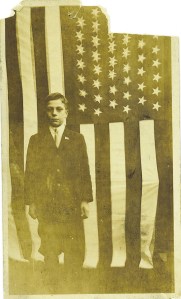
Grandpa at his brother’s memorial service, 1920.


When he was very young, my older brother was in danger of getting drafted when he turned eighteen. Much to our mother’s relief, Nixon ended the draft in 1973, and I never had to worry about a sibling going off to war.

My grandpa wasn’t so lucky. While his seventh grade class was busy knitting vests for soldiers overseas, his own big brother, Howard, was caught up in the fervor to fight The War to End All Wars, and enlisted in the infantry. In May 1918, after seven months of training at Camp Hancock, he departed for France. Two months later, on the first day of his regiment’s confrontation with the enemy, Howard was killed by machine gun fire in the Conde Woods.

A comrade reported seeing him lying wounded a few hours after the attack, asking for water, but the man had none and knew that the enemy was returning, so he left without helping. A few days later, a patrol looking for bodies found Howard’s about 200 yards from where he had last been seen, and buried him with twelve other soldiers in a grave near Marne. Two years later, his body was disinterred and shipped back to Pennsylvania, where he received full military honors.

My grandfather said that his parents were in denial when they got the news of Howard’s death. When the remains were finally returned home, the family was offered the opportunity to identify the body, but declined. As a result, his father was able to hope until the end of his days that there had been a mix-up, and that Howard might someday return.

He didn’t.

This post is dedicated to brave men long forgotten, and to the families that had to go on without them.

References: History of the 110th Infantry (10th Pa.) of the 28th Division, U. S. A. (Published by The Association of the 110th Infantry, 1920); Personal recollections of Clair H. Brewer, Sr.

7 Comments

Filed under Miscellaneous

The Valentime

The boy labored over the card, a red ballpoint in his hand. He drew a heart-shaped dartboard with an E in the center, a scoreboard with Love written at the top and the name Emma fifteen times. Giant red darts that looked like rockets filled the corners of the paper. His tongue peeked out at the corner of his mouth as he wrote, “I shuw hopen you like this card. Love, Jake.” He folded it in half and added it to the glittery wooden heart he had persuaded his mother to purchase at the craft store.

“Mommy, when aw you goween to make an envelope fow Emma’s valentime?” His auditory processing problem was evident when he spoke; the garbled sounds of the words he heard were converted to speech. After five years of therapy, he was understandable, but still sounded less mature than his seven years.

His mother was over at the kitchen sink, washing up the pots and pans from dinner.

“Why don’t you write the names on your other valentines, and I’ll do it when I’m done?”

With a slight scowl, he freed the box of valentines from its cellophane wrapper and got the list of names out of his backpack.

“Have you even seen Emma lately?” his mother asked. Emma had moved up to the gifted program at the start of the school year, along with Jake’s best friend, Niles. Jake had been passed over because his disability interfered with the testing and his scores were low.

“Well, I saw hew at wecess.”

“Did she say hi?”

“No. But I did see hew in da dwivah line, and she waved at me.”

A moment passed.

“Does Emma love you, too?” The real question.

“I don’t think so, but if I give hew enough pwesents, she will,” he said with confidence.

That made his mother smile, but she cautioned, “Well, maybe. There are lots of other little girls, you know.”

“I know dat,” Jake said, “but I love Emma.”

His mother dried her hands on a towel and walked over. Picking up the pink sheet of acetate Jake had chosen, she quickly fashioned an envelope large enough to accommodate the card and sparkling heart. She was an artist, and knew how to make all kinds of things. Jake watched her swift movements with admiration.

“There,” she said, slipping the gifts inside and sealing it. She handed it to him. “You can write her name on the front. E-M-M-A.”

“I know dat,” Jake protested. He always knew more than she thought he did. He wrote the name and carefully put the envelope into his backpack.

Emma would like it — he knew that, too.

2 Comments

Filed under Miscellaneous, Reading, Uncategorized

What Makes a Classic?

I was reading on an agent’s blog today about the fact that there are, as we all know, trends in publishing. Right now, it seems that prologues and adverbs are out. So is reality (for YA, anyway). So are boy books. So is literary fiction, unless it’s really great.

Most of the time, the books that ride the waves of these trends wash up on the literary shore and are taken away by the next tide. We can all name some of those. A few, however, rest like like shells on a beach, picked up by the discerning eye and treasured. We can all name some of those, as well.

What sets these books apart? I happen to be a member of AQ Connect, and there is always dismay when a prizewinning novelist seems to break all the rules. Adverbs abound, there is a 30-page prologue, the author tells instead of showing. Why is it that people who try to follow the rules have such a hard time making it, while people who break them can be stars?

Agents write about how they cannot exactly say why a book has “it,” just that they know it when they see it. Charles Dickens had “it,” as did Jane Austen, Louisa May Alcott, L.M. Montgomery, F. Scott Fitzgerald, Ernest Hemingway, and Harper Lee. Many of their works still enjoy a shelf at the bookstore, although ironically, there is plenty of discussion online as to whether those authors would even be able to get an agent today, let alone get published.

Many agents are not shy to admit that they frequently turn down work that they love, because they don’t know for certain that they could get a publisher to buy it, but in the same breath, they say that you shouldn’t write for the market. I, myself, loosely follow the advice of Madelyn L’Engle: “You have to write the book that wants to be written.” (And worry about getting published later.) I’ll let you know how that goes.

Leave a comment

Filed under Critical Thinking, Miscellaneous, Uncategorized, Writing

A Bird in a Gilded Cage

I think that computers are marvelous, and feel blessed every time my fingers fly across the keyboard. Words seem to shoot directly from my head onto the screen.

I remember HATING to write when I was in high school — my hand would always cramp up, and longhand was so slow. When I tried to write fast enough to keep up with my thoughts, I wouldn’t be able to read it afterwards.

My first manuscript was written on my computer at home, in our cave of a study. I appreciated the ease of putting my thoughts down, editing, etc., and being able to do research at the drop of a hat via the internet, although it was a little lonely.

Last fall, I finally got a laptop. I wasn’t aware of feeling caged before, but now I feel like I have been set free. No place is off limits. The library, the park, restaurants, even my car when I’m waiting to pick up my sons from piano lessons… you name it, I’ve written there. It’s the best of both worlds; no one bothers you, but you are still connected to the sea of humanity milling pleasantly around.

My favorite place to go in the wintertime is Starbucks. They have a wonderfully cozy fireplace right next to the little table where I like to write. You do have to purchase something, but I can think of worse torture than a cup of hot cocoa and a muffin. Somehow, I always feel slightly naughty when I write there, like I’m getting away with something, but in a good way.

Where do you write?

2 Comments

Filed under Miscellaneous, Uncategorized, Writing