Monthly Archives: May 2010

The Ultimate Sacrifice

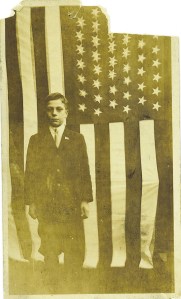
Grandpa at his brother’s memorial service, 1920.


When he was very young, my older brother was in danger of getting drafted when he turned eighteen. Much to our mother’s relief, Nixon ended the draft in 1973, and I never had to worry about a sibling going off to war.

My grandpa wasn’t so lucky. While his seventh grade class was busy knitting vests for soldiers overseas, his own big brother, Howard, was caught up in the fervor to fight The War to End All Wars, and enlisted in the infantry. In May 1918, after seven months of training at Camp Hancock, he departed for France. Two months later, on the first day of his regiment’s confrontation with the enemy, Howard was killed by machine gun fire in the Conde Woods.

A comrade reported seeing him lying wounded a few hours after the attack, asking for water, but the man had none and knew that the enemy was returning, so he left without helping. A few days later, a patrol looking for bodies found Howard’s about 200 yards from where he had last been seen, and buried him with twelve other soldiers in a grave near Marne. Two years later, his body was disinterred and shipped back to Pennsylvania, where he received full military honors.

My grandfather said that his parents were in denial when they got the news of Howard’s death. When the remains were finally returned home, the family was offered the opportunity to identify the body, but declined. As a result, his father was able to hope until the end of his days that there had been a mix-up, and that Howard might someday return.

He didn’t.

This post is dedicated to brave men long forgotten, and to the families that had to go on without them.

References: History of the 110th Infantry (10th Pa.) of the 28th Division, U. S. A. (Published by The Association of the 110th Infantry, 1920); Personal recollections of Clair H. Brewer, Sr.

7 Comments

Filed under Miscellaneous

Ghost from the Past: Elements of the Modern Novel

I fell asleep last Saturday night with the TV on. When I woke up in the morning, the movie Ghost was just starting. Ghost is my brother’s favorite movie, but I had never seen it. Twenty years of mild curiosity (and my reluctance to crawl out of bed before I absolutely had to) overcame me, and I flopped back onto the pillows to watch.

It didn’t take long to see why the film was such a hit, and not much more time to realize that the movie includes many elements of a good novel. (Note: I am assuming that everyone else has already seen Ghost. If you haven’t, head over to Netflix before you read any further —I don’t want to spoil it for anyone.)

1. Hook the Reader:
After some eerie but beautiful music and a brief pan of what appears to be a dusty attic space, the film literally breaks into the action with a sledgehammer through a wall. We are immediately introduced to the main characters (Sam and Molly) and their relationship. Once a reader is hooked, he/she will keep reading.

2. Work in backstory as you go along:
Imperceptibly, we see by his inclusion in the demolition that the couple is friends with Carl, and that he is a coworker of Sam. Swiftly, the viewer realizes that they are bankers, and just as swiftly, that secret codes are best kept secret. Backstory is more easily digested when it is revealed as needed.

3. Only include information that advances the plot or exposes character (to paraphrase Mr. Vonnegut):
We never do find out why the lovebirds seem to have no close friends except for the bad guy, but that doesn’t really matter. If it’s not pertinent to the story, the reader can live without it.

4. Weave in subplots: Oda Mae’s history of being a con artist messes up the original plan of convincing Molly that she needs to protect herself. It is also intriguing that the subway ghost seems to have been a victimized homeless person, and the $4 mil check ends up benefitting a homeless shelter. Subplots lend meaning to a story.

5. Don’t forget the twists: Carl’s character is an impressive source of the unexpected. First, he turns out to be the enemy instead of a friend, THEN he comes on to Molly after Sam’s death, and instead of being scared away by Sam’s ghost, he blackmails him with a threat on Molly’s life. Twists keep the reader engaged.

6. Give the reader the inside scoop:
The audience knows that Carl is the bad guy, but somehow, Sam just doesn’t get it. The suspense is in whether or not he will figure it out before it is too late, and the viewer is worried for him and Molly. A reader will root for a character who is at risk but doesn’t know it.

7. Include some foreshadowing:
There is plenty of foreshadowing in Ghost. “Can you keep a secret?” asks Sam of Carl, right before he goes on to tell him  about the confusion with the accounts. (We know how that turns out!) Later, a ghost mentions in passing [pun intended] that entering someone else’s body is debilitating, but we forget all about that until Sam is suddenly stricken after a visit á la Oda Mae. We also get a dash of premonition when the hospital ghost says that the dead guy was lucky to go to heaven, because sometimes it goes the other way. Foreshadowing adds dimension to a problem/conflict. 

8. Focus on character development: When Sam is first dead, he is completely powerless. As the film progresses, he grows in ghostly knowledge and capabilities, seeking out other ghosts to teach him. He also discovers Oda Mae and achieves his goal of communicating with Molly. By the end of the story, he has used his hard earned skills to save the her. Oda Mae changes from being a con artist to fulfilling her destiny as a ghost whisperer and making a positive difference in people’s lives. Carl experiences character development as well, going from getting involved with the wrong guys to being responsible for a murder. In greedy desperation, he turns into a murderous villain, himself. Character arcs are integral to good storytelling. 

9. Fake out the reader for more suspense: We think that the action is on its way to being wrapped up, with the murderer gone and Sam in full possession of his ghostly capabilities, but he is unexpectedly weakened at the moment of crisis, and we don’t know what is going to happen. Lead the reader through a maze of possibilities to heighten the tension.

1o. Incorporate themes: The most obvious themes in Ghost are “good vs. evil,” and “love conquers all.” Without them, Ghost would be just another urban paranormal. Archetypes grab the reader on a gut level.

11. Denouement:
Immediately after Carl bites the dust and heads South, the pace slows, and we enjoy a leisurely stroll to the end of the film. The swirling light from heaven enables Molly to see and hear her beloved, and there is a tender moment between them as they say goodbye for the last time. The film wraps up with Sam departing for the great beyond. After the crisis has passed, let the reader catch their breath.

12. Tie up loose ends:
Both bad guys are dead, Sam and Molly have exchanged words of love, Oda Mae has turned over a new leaf. Conclusion achieved. Don’t leave unanswered questions (unless you plan a sequel).

A lot of things have changed in twenty years, including Demi Moore’s nose, but the elements of good storytelling will never die.

4 Comments

Filed under Writing

What You See is What You Get

There is an interesting aspect to vision that many people aren’t aware of. When we look at something, it seems as though we are viewing a homogenized image, as if the body’s camera has all of its pixels activated and every nuance is just waiting to be observed.

Except that we’re not. It is a fascinating fact that the end result of what we see is much different than what our eyes actually observe. Our brains translate two separate points of view, compare and constrast shades of color, and translate the dramatic delineation of objects into a picture perfect scene. While the eyes supply the nuts and bolts of an image, the brain interprets and makes sense of things, filling in the blanks by merging available information with previous experience.

Most of the time, this system works well. Our cognitive ability, combined with the movement of the head to scan an area, usually enables us to see what there is to see. Sometimes, though, we think we see things that upon second glance are really something different, like when a cat runs across the road but then we realize it was a fox, or when we look down into the Grand Canyon and things appear to be 2-dimensional even though we know they are 3-dimensional. 

In many ways, this is similar to the picture that happens in our heads when we read.  The author supplies bits and pieces, and the reader fills in the blanks. Most people don’t need 100% of the image to see what’s going on. A character might be “a six year old female, 3’4,” sixty pounds, with braided blonde hair, eyebrows in a darker shade, blue eyes and knobby knees,” but, “A chubby little girl with blonde braids and a determined expression” is really all the reader needs, unless the knobby knees figure into the story somehow.

For centuries, readers have depended on this flow of communication between author and psyche to provide enduring mental images. These days, however, there seems to be a tendency for writers to either blatantly spell things out (always showing, never telling) or to skip details entirely (eliminating adverbs and adjectives), leaving the reader bereft of the joy of “the movie in your head.”

The Help, by Kathryn Stockett,* is one of the most engaging books that I’ve read in a while, and I happily stayed up late to finish it. The reason that I didn’t give it a higher rating was because after I read it, I didn’t experience my usual reliving-the-best-parts-of-the-story-in-my-head-later afterglow. It was just, “The End.” I was able review the course of events in my mind, and had mental images of the toilets on the lawn, Mae Mobley perched on the pottie in the wrong bathroom, and the stain on Miss Celia’s carpet, but there was a depth of field that was missing. 

What I suspect was at the heart of the problem, was the current trend of deleting most adverbs and adjectives. For me, that removes a lot of the visual aspects of a read. I don’t think that stories should be hazy with purple prose, but I like the subtleties of language that adverbs and adjectives can supply. I enjoy knowing about the quirky eyebrows on the teacher, or that the mother said something in a mysterious way. Those details are parts of the picture that the author has painted, and I want to see them. I don’t go to an art museum to look at a coloring book and fill in the pictures myself — I want to see a completed masterpiece, the world as the artist sees it.

Similarly, I want to see a story through the author’s eyes. If I like it, I like it, if I don’t, I don’t. If a writer wants to fill in some information with an adjective, I’m all for it. My vision is a little skewed, anyway.

* To see my review of The Help, click to read the first-half and final-review posts.

3 Comments

Filed under Uncategorized

Hmmm.

Was going to post this evening, but realized that I need to do a little more fact checking on the content. Today’s installment will be posted tomorrow, instead. See you then! 🙂

Leave a comment

Filed under Uncategorized

Word Game Review: Pairs in Pears

The other day, I posted about Bananagrams and how I was waiting for the companion books and Pairs in Pears game to arrive. Well, they did, and I’ve already enjoyed several hours of word puzzle fun.

One of the reasons I decided to order Pairs in Pears was that Amazon’s Product Description was, “A fun way for children to develop memory and cognitive skills while learning alphabetical order, word construction, consonants, and vowels, vocabulary, rhyming, etc. Entire alphabet in each of 4 patterns (104 ivory-like tiles) Ages 5+.”

Banangrams is for ages seven and up. I am closer to up, so that was what I had put on my birthday list. My youngest son is actually seven, but is unable to play Bananagrams easily, due to a learning disability (sort of like dyslexia for the ears). As a result of his issues, he has difficulty rhyming and sounding out words. I hoped that Pairs in Pears might help him and be fun at the same time.

There are many ways to play, all of them simpler than Bananagrams. In each variation, the players split up the letter tiles and try to make crossword pairs, with three or more letters in each word. When my son and I sat down to play, I was pleased to see him enjoying himself, mastering words for once, rather than being frustrated by them.

As the game progressed, I noticed that being able to hold the tiles in his hands and move them around seemed to help him figure things out. Rather than commiting the letters to a page (and getting them “wrong”), he could manipulate them until they seemed right. When we were done, he wanted to play again. 

School is out in a few weeks, but next week is his last visit with the reading tutor. He told me that they only write things down in her class, so we’ve decided to get her Pairs in Pears as a goodbye gift. Maybe my son can teach her a thing or two.

2 Comments

Filed under Uncategorized

Gone But Not Forgotten: Author E. Nesbit: 1858-1924

Last weekend, I scoured the Kindle Popular Classics in search of something good to read. Paging through, I spied a familiar children’s author, E. (Edith) Nesbit. I had read and enjoyed The Enchanted Castle as a child, but her other titles hadn’t been available at our library. Out of curiosity, I downloaded The Railway Children.

I have no idea what age group the book was originally intended for (I would guess second-graders), but now it would definitely be considered Middle Grade (9-12 year olds). Written in 1906, the language is somewhat dated, but it’s interesting to note that Ms. Nesbit was ahead of her time in style, employing minimal dialogue tags. I am several chapters into the book, and so far have only seen “asked,” “said,” and “cried.” The use of adverbs is limited, as well, although adjectives are used freely. So far, other than a red-haired maid, there have been few descriptions of the characters. I know how old everyone is, what their names and nicknames are, and have a general impression of the clothing/setting/era, but Stephen King would be proud.

Nesbit was one of the first writers to incorporate magical events into the lives of otherwise realistic characters. In fact, she was quite a renowned author in her day, and her work heavily influenced other authors of the time, including C.S. Lewis and Edward Eager, as well as more modern authors such as J. K. Rowling.

Not unusual for a writer in any era, she had an interesting personal life. Ms. Nesbit was born and raised in England, and her father died when she was four. Her family moved frequently throughout her childhood. She didn’t marry her husband, Hubert Bland, until she was obviously pregnant with their first baby. In addition to the three children they had together, Mr. Bland had a long time affair with another woman, and Edith raised their two children, as well. She and her husband were extremely active in politics.

Although her lifestyle was far from exemplary, it did not seem to affect her popularity as a children’s writer. Some of her more famous titles were, The Story of the Treasure SeekersFive Children and ItThe House of ArdenThe Railway Children and The Enchanted Castle, many of which are available on Kindle Popular Classics (for free), and at Amazon.com.

Try one — they’re good.

2 Comments

Filed under Uncategorized

Going Bananas

I have been waiting impatiently since last week for a box to arrive from Amazon.com. One might presume that it is a book order, and it is, but not the sort of book order one might think. It is a BANANAGRAMS order!!! 

I got the game Bananagrams for my birthday last month, and I love it. First of all, it comes in a zippered banana. Inside are letter tiles similar to Scrabble, but weightier in the hand and ivory smooth. Each person selects some tiles and forms their letters into a crossword. Everyone takes more tiles from the center, as needed, and the other players are forced to do the same until someone’s letters are gone and he/she has an uncontested network of words.

The game is fun, but I also like the companion puzzles included in the instructions. They are simple challenges, such as starting with five words and adding an A to each to make five new words, etc. They are only about a “one” in the difficulty factor, tempting crumbs which lead to the advertisement for the Bananagrams book.

Much to my joy, when I went on Amazon to look for it, I also discovered More Bananagrams, and another game by the same company called Pairs in Pears, which I ordered, too. (There’s another one called Appletters, but I’ll have to wait until Christmas for that.)

All of the items were eligible for Free Super Saver Shipping, but of course, that takes longer.

And so, I wait.

2 Comments

Filed under Uncategorized

Just a Trim, Please…

I took my boys to the barber today for their quarterly haircuts. I wanted them to get summer cuts (short) so that they wouldn’t need to go back until school starts in the fall. Neither boy wanted to go, but my youngest was philosophical. “Just tell Char that I want it like it is now, but shorter.” 

My oldest was another story. At the end of fifth grade, he is very aware of what’s cool and what’s not, and apparently short hair is not. The most prevalent style at the school he attends is basically what he already had: overgrown, slightly past the collar, with bangs pushed just far enough to the side to not interfere with his vision.

In the waiting area, he went through various stall tactics until he realized the futility of that (I threatened him with cutting it myself) and sat down in the chair. Stone faced, he would not speak to the barber, and I finally took pity on him and told her not to buzz it or anything, just trim it a little bit and keep it long in the front.

Several minutes later, I looked over and saw that she had not understood. It was shorter, and she had left it long in the front, but the sideburns were somehow non-existent. The whole look was similar to a cube with a face in front. My son had tears in his eyes, and I could understand why. “Uh, maybe trim up those sideburns a little bit, and expose the ears,” I suggested.

“But this is how they’re wearing it,” said the barber.

“Not at his school!” I said.

She did what I asked and it looked better, but as far as my son was concerned, the damage had been done. He glared at me as she vacuumed his neck, and was muttering fifth grade cuss words as I paid her. Rather than expressing gratitude for my saving him from total humiliation, he whispered, “I hate you.” 

It occurred to me that the process of editing was similar for me. I liked my manuscript the way it was. I didn’t mind trimming a few adverbs here and there, and was grateful when critique partners pointed out echoed words, but when they suggested some changes that were more dramatic than that, I experienced a great deal of conflict. It was not that I didn’t see the value of their ideas, it was that I knew what I wanted it to look like, and that’s what I wanted to go with. Striving to be reasonable, I weighed their suggestions and realized that the story might benefit from some of them. The current version is not dramatically different, but the pace is better and the action begins earlier. I suspect that it is more marketable than it was.

As we left the barbershop, I noticed that my son’s hair actually looked pretty good. In my opinion, there had been a happy compromise between what each of us wanted and what he’d ended up with. I don’t expect him to admit it, but I think that he basically felt the same way. By the time we’d made it to the parking lot, he was playing with the little car he’d chosen on his way out, and hasn’t mentioned the haircut since.

3 Comments

Filed under Uncategorized

On Giving Up

Cate Woods blogged recently about beta readers, and the comment that I wrote has been rolling around in my brain this week, due to the rejection of yet another partial manuscript.

I have sent out more than sixty queries. One agent has requested to see my full manuscript, and six others have requested partials. All of these submissions were ultimately rejected. Many of the responses have been that the manuscript seems like a good, well written story, but no one is AS in love with it as they would need to be to sell it in this market, and/or they are not sure where they would place it.

This is discouraging. It makes me wonder if I should throw in the towel, and maudlinly reflect that my manuscript might just be too beautiful to live. But then I start to think of why I should keep going.

When I was finished with the original draft, I contacted a few teacher friends around the country to ask if they would offer it to students in my target group (gifted middle-school boys) to read and answer an accompanying questionnaire. I didn’t want kids who knew me, because I thought that might interfere with the honesty of their answers.

I ended up with ten guinea pigs beta readers, all tempted by the promise that I would put their names in the acknowledgments section if the story gets published. A few girls wanted to read it, too, which was fine with me. I stressed in the questionnaire that I wanted to know what was wrong with it, and that anything just written to be nice might hurt the chances of it getting published. I also asked them to write down the words they didn’t understand, so that I could include it in a glossary (gifted kids enjoy things like glossaries).

Although one girl wanted me to work a vampire into the story, the rest of the readers really liked it. They mentioned a few questions they’d had that had gone unanswered (which I fixed), said that they would recommend it to friends, and offered unsolicited ideas for sequels. One said to his teacher that Jim and Jack is one of the best books he has ever read.

One question on the form was about whether or not they thought they were the right age to read it, and if not, what age would they recommend? The students ranged from 11-16, and each thought that their age was exactly the right one, for different reasons. None of them wrote down words for the glossary, which didn’t surprise me; gifted boys don’t usually like to admit when they don’t know something. 

This is what keeps me going, when I am feeling down about querying, and when adult beta-readers/critique partners suggest that it might be MG instead of YA. I’m not sure exactly how to find an agent who thinks like a gifted teenaged boy — that’s not the sort of information that gets shared in profiles or on websites. If there’s one out there, though, I intend to hang in there until I find him/her.

What keeps you querying?

3 Comments

Filed under Uncategorized

Wednesday’s Post

Oops, it’s almost Thursday and I haven’t posted yet. See you tomorrow! 🙂

Leave a comment

Filed under Uncategorized